
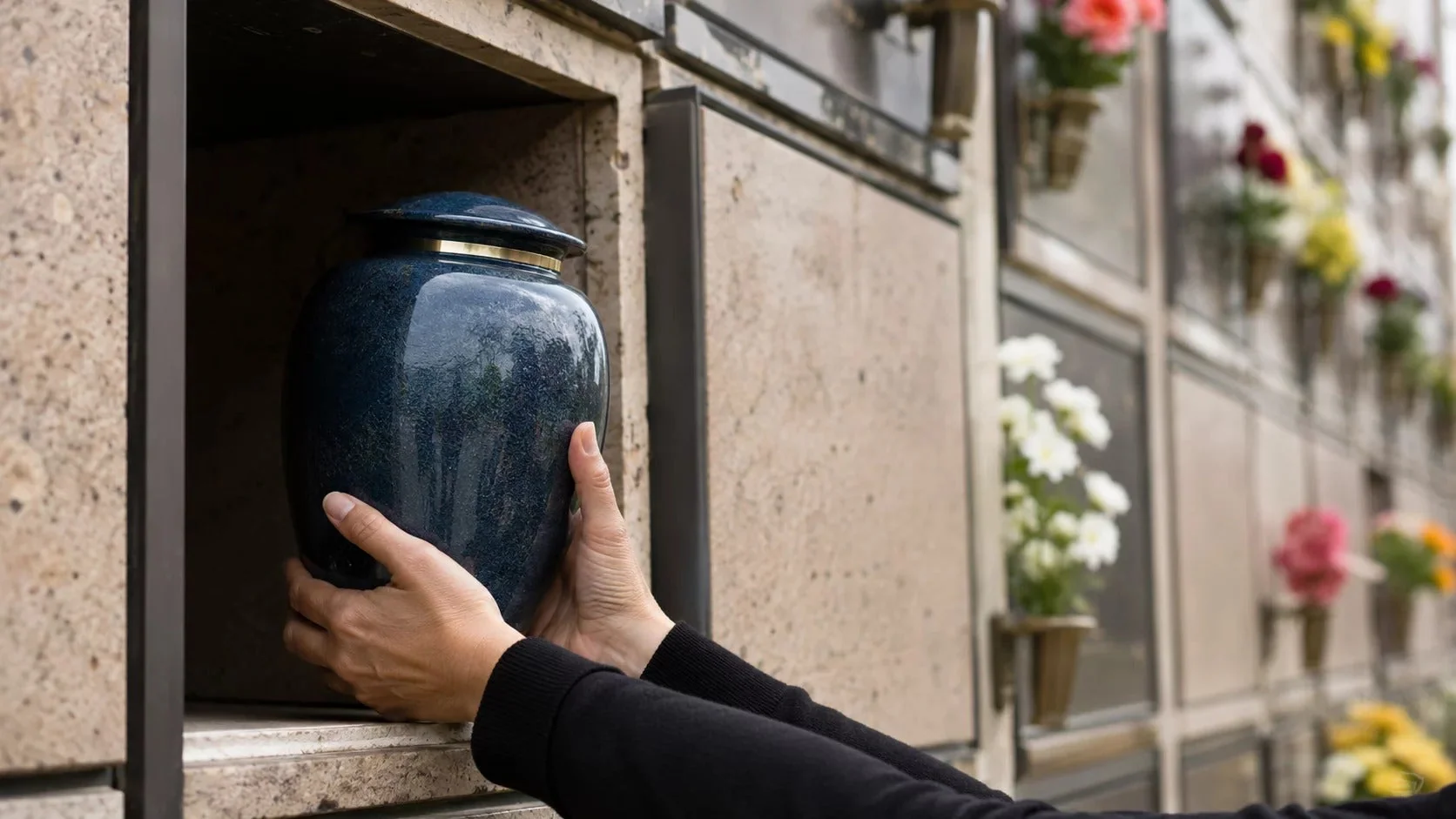
Choosing an urn for a cemetery begins with the space and the cemetery’s rules. An attractive container may be unsuitable if it is too large for the niche, cannot fit inside a required outer container, or conflicts with the planned arrangement. Obtaining written specifications first allows the family to compare suitable designs with confidence and reduces the chance of a costly change after personalization.
The cemetery can also explain questions that a product seller cannot answer, such as who may authorize placement, what the reservation includes, and how a later companion placement would work. Treat the urn and the cemetery arrangement as connected decisions. The following questions provide a practical structure for the conversation, whether the family is choosing a new location or using an existing family space.
What type of placement is being arranged
Clarify the actual arrangement in plain language. CANA describes a columbarium as a structure containing compartments called niches for cremated remains. Ground placement is a different arrangement and may involve an outer container under the cemetery’s rules. Ask staff to show the exact location and explain what the family is purchasing or already has the right to use.
Do not rely on a broad label in a brochure. Terms such as family space, companion niche, or cremation garden can cover different arrangements at different cemeteries. Ask how many people the space can accommodate, whether separate urns are expected, and whether the remains are individually identifiable and retrievable under the terms of that specific arrangement.
Discuss the experience of visiting as well. Consider distance from family homes, opening hours, parking, pathways, seating, and whether the location is indoors or outdoors. These factors may matter more over time than a decorative feature viewed during the initial tour. If a relative uses a mobility aid, evaluate the actual route rather than assuming the grounds will be equally accessible in every area.
What are the exact usable dimensions
Request the interior height, width, and depth of the reserved niche, plus the clear opening through which the urn must pass. Confirm whether any frame, door, ledge, or closure reduces the usable space. Ask the cemetery to put those measurements in writing. A photograph or general estimate is not a reliable substitute for the dimensions of the specific unit.
Urns should then be shortlisted by their full exterior dimensions, including the base and lid. Share the manufacturer’s specifications with the cemetery before ordering. If the urn has a broad shoulder, projecting ornament, or unusual shape, send photographs from more than one angle. Ask for confirmation that the selected design is suitable for the intended placement.
Leave practical clearance rather than planning a fit with no margin. Staff must be able to place the urn without forcing or damaging it. If two containers will share a niche, check the combined arrangement, including their orientation. A pair of products that each fit individually may not fit together, and a narrow opening can complicate an otherwise adequate interior space.
Is an outer container required for ground placement
If the urn will be buried, ask whether the cemetery requires an urn vault or other outer container. Do not assume that a sturdy urn removes this requirement. CANA notes that burial may require a vault, depending on the arrangement. The relevant answer comes from the receiving cemetery and should be included in the written specifications for the planned placement.
When an outer container is required, obtain its usable interior measurements and confirm which urns fit inside it. Include the closure and any lining in that discussion. The outer dimensions of the vault are not the same as the room available for the urn. Ask who supplies the container, who checks the fit, and when it must be delivered.
If the family prefers a biodegradable urn or another specific material, discuss that preference before purchase. Ask whether the cemetery offers an arrangement compatible with it and whether an outer container changes the intended result. A product’s environmental description does not establish cemetery acceptance or determine how it will behave in the actual placement conditions.
How would a second placement work later
For a couple or family arrangement, ask how future placements are handled. Will the first urn remain in position while another is added? Is there a limit on the combined size? Can a companion urn be used, and would it need to be removed to add the second person’s remains? The answers can influence whether one shared vessel or two separate urns is more practical.
Confirm whether the space is reserved for both people and what paperwork records that intention. Ask which costs are paid now and which may arise later. A purchase that covers the right to use a location may not include every future service or inscription. Have the cemetery explain the agreement in ordinary language before the family relies on it for a long term plan.
Think about differences in timing and preferences. One person may want a traditional design while the other prefers something simpler. Two coordinated urns can allow those choices while still creating a shared placement, if the space permits. A companion design may suit another family better. The correct answer depends on access, capacity, space, and the wishes involved rather than visual symmetry alone.
What identification and personalization are permitted
Ask whether the urn itself will be visible after placement. A transparent front and an enclosed niche create different display conditions. If the urn will be hidden, the family may prefer to place more emphasis on the exterior inscription or marker. If it will be visible, ask about orientation, allowed objects, lighting, and whether there are restrictions on the appearance of the contents.
Confirm the inscription process separately from the urn purchase. Who provides the plaque or niche lettering? What information is required? Which fonts, symbols, dates, or images are allowed? Request a proof and establish who will approve it. Check names against the family’s records, including accents, initials, and any cultural naming conventions that could be misunderstood.
Ask about flowers and other objects before planning a display. The cemetery may have specific rules about placement, removal, seasonal arrangements, or items attached to a niche cover. Get those rules directly from the location. A nearby niche with a decoration does not necessarily show what is permitted, and families should not have to learn the policy after an object is removed.
What does the quoted price include
Request an itemized explanation of the arrangement. Separate the right to use the space from placement services, opening and closing, inscriptions, an outer container, administrative charges, and any ongoing care provisions. Ask which items are optional and which are required by that cemetery. This makes it possible to compare alternatives without assuming that similarly named packages contain the same services.
For future arrangements, ask how quoted prices and prepaid items are documented. Identify what is covered if costs change and what remains payable later. If a contract includes restrictions on transfer, cancellation, or refund, ask for an explanation before signing. Keep financial questions focused on the written agreement rather than relying on a verbal reassurance that everything will be taken care of.
Consider the complete family budget. Travel, a small gathering, flowers, printing, and the urn itself may fall outside the cemetery quote. These expenses need not be elaborate, but recognizing them early helps avoid rushed decisions. The family can then choose where spending matters most and keep other parts of the arrangement straightforward.
Who coordinates delivery and the day of placement
Establish whether the urn should be delivered through the funeral provider, brought by the family, or received directly by cemetery staff. Ask when it must arrive and what documents accompany it. Identify a named contact who can confirm receipt. If the urn is personalized, build in time to inspect the spelling, finish, and physical condition before the scheduled placement.
Ask how much time is available for a gathering and where attendees should meet. Confirm whether chairs, shelter, or an officiant are provided or arranged separately. If bad weather is possible, discuss the available alternative. These details help the family communicate a clear plan to guests and avoid treating the cemetery appointment as an open ended event.
Once the placement is complete, request the location record and keep it with the relevant agreement. Share a copy with trusted relatives who may visit or handle future arrangements. A map, niche number, or section reference can be much more useful than a photograph alone. Confirm the cemetery’s preferred method for updating family contact information after a move.
Bring a short checklist to the appointment
If two cemeteries remain under consideration, compare their answers using the same questions. A lower initial quote may cover fewer services, while a more distant location may be harder for relatives to visit. Ask a family member who did not attend the appointment to read the written details. If they cannot tell what has been selected, what is included, and what remains undecided, request clarification before ordering the urn or approving the final arrangement.
Before the meeting ends, confirm that the family has the following information in a usable form:
- The exact location and type of placement.
- Usable dimensions and any material or outer container requirements.
- Approval for the proposed urn or a clear process for obtaining it.
- The number of people the space may accommodate.
- An itemized price and an explanation of future charges.
- Inscription, decoration, delivery, and ceremony instructions.
- The contact responsible for the next step.
These questions turn a broad decision into a set of details that can be checked. Once the cemetery requirements are clear, choosing the urn becomes a more focused and personal process. The family can concentrate on a design that reflects the person being remembered, knowing that the practical arrangements support the place they have selected.
Sources
Cremation Association of North America — Cremation Memorial Options
